MedWOW is THE multilingual online marketplace for trading medical equipment and connecting buyers and sellers globally.
Hundreds of thousands of complete systems, parts, accessories, and medical supplies are posted for sale and auction!
The user-friendly, international website connects buyers, sellers and service providers of medical equipment from all over the world by offering: comprehensive professional services, unprecedented reliability, multilingual customer support and top value.
Summarizing the complicated and varied technology in the field of MRI in a brief description represents a challenge. However, it is helpful to know the basic types MR techniques and terminology as the technology has become ubiquitous in patient care. The following is by no means a complete description of MR technology but can help to orient someone new to the field. Magnetic Resonance Imaging is based on localizing hydrogen atoms in tissue using radiofrequency wave pulses in an applied magnetic field. As the patient lies in the scanner, a magnetic field is applied, which causes the hydrogen proton in the body to “spin” in the direction of the magnetic field. There are two major types of magnets used: permanent magnets and superconducting magnets. Permanent magnets can be thought of a two bar magnets made of metallic alloys that produce a inform magnetic field between them. Another type of magnet is a superconducting magnet, which is encased in liquid helium to prevent energy loss.
The MRI lets medical professionals see an image of internal structures. Before 1977, when the first human MRI was performed, surgery was the only way to visualize internal body structures. The first MRI back then took 5 hours to produce just one very unclear picture. Since that time, vast improvements in technology have resulted in MRI scans that take 60 to 90 minutes and result in very high-quality images.
Though very safe, MRI’s are not totally safe for all individuals. The “magnetic” part of the name is what allows the representation to be created. The MRI magnet relies on a strong magnetic field to produce the image. This magnetic field is also the source of the danger. Any metal that contains iron can be attracted to the MRI magnet. Therefore, items that can be problematic or dangerous include: jewelry, pacemakers, dental implants, paperclips, pens, keys, or other small objects. These objects can be forcibly pulled out of pockets and travel at high rates of speed into the MRI magnet core of the MRI unit. This poses a great risk for the patient being scanned. Due to this, the MRI technicians are very meticulous about determining if a patient has any metal in or on their bodies. Some people with any sort of internal metal implant may be denied an MRI, due to a possible threat from the high magnetic field.
The magnetic field used in an MRI is expressed in two comparative values: Tesla and gauss. One Tesla is equivalent to 20,000 gauss. The magnetic field produced by the earth is 0.5 gauss. The most common MRI magnets used today are 0.5 Tesla to 2.0 Tesla (magnets greater than 2 Tesla have not been approved for human use, but are used in research). This means that the magnetic field used by a typical MRI is approximately 40,000 times stronger than the gravitational field of the earth.
This large and powerful magnetic field is why MRI technicians carefully control who and what enter the MRI scanner suite.
The most common MRI magnets used in contemporary scanners are called superconducting magnets. This is a typical resistive MRI magnet, composed of coils or windings of wire, through which a current of electricity is passed. The MRI magnet has a significant distinctiveness: the coiled wire is bathed in a solution of liquid helium. Helium becomes a liquid at 452.4° below zero. This extremely low temperature lowers the electrical resistance of the wire to near zero, allowing relatively small amounts of power to create the large magnetic field.
In general, two types of MRI magnets make up the scanner. The superconducting magnet produces a very large magnetic field of uniform strength and stability. Smaller gradient MRI magnets are used to create small variations in the magnetic field. It is the interaction of these two magnetic fields that allows an image to be produced. A complex and powerful computer system interprets the interaction of these magnetic fields, to produce the viewable image that is the inside of your body.
MRI magnets of all kinds can be found in the MedWOW marketplace, as well as all types of imaging equipment systems and parts. MedWOW is committed to providing medical professionals around the world with secure alternatives to finding replacement parts that match their systems and at competitive prices.
Some of the MRI magnets and MRI magnet replacement parts that can be found on MedWOW include: GE Healthcare Signa Horizon 1.0T Magnet Enclosure #450009, Siemens Mobile MAGNETOM Impact SYPHON MAGNET END #1644728, GE Healthcare Signa Horizon LX 1.5T Magnet Encloser Power Supply and many more examples.

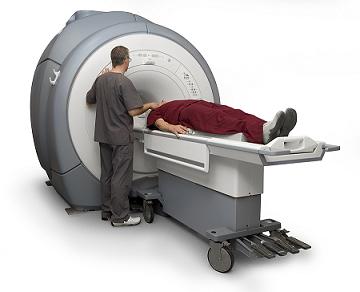 Summarizing the complicated and varied technology in the field of MRI in a brief description represents a challenge. However, it is helpful to know the basic types MR techniques and terminology as the technology has become ubiquitous in patient care. The following is by no means a complete description of MR technology but can help to orient someone new to the field.